
Only 7% of companies have fully scaled AI across their organizations, according to a recent McKinsey report. The reason is consistent across the research: more than two-thirds of high-performing companies name data as the primary obstacle to enabling AI.
The good news for executives is that solving the data problem now carries a measurable payoff. The McKinsey case study puts a dollar figure on it: $10 to $20 million in cost avoidance from building a reusable unstructured data foundation.
The $10-20 Million Case Study
A financial-services company rebuilt its unstructured data pipelines with the same rigor traditionally applied to structured enterprise data. The effort focused on documents, images, audio files, and other inputs that had to be parsed, extracted, quality checked, and enriched for AI.
The company recognized that a source artifact was no longer a single static object. A PDF could produce extracted text, tables, images, image summaries, metadata, sensitivity tags, and quality scores. These outputs stayed connected to the original source and to each other, preserving meaning, lineage, and control as they moved through the pipeline.
Then the company packaged this processed content into curated, governed datasets that applications could reach through text, metadata, and vector search, as well as APIs. Teams retrieved the right documents, passages, tables, or entities before sending context to a model.
The firm also built one reusable unstructured data pipeline that every team could share. The core steps stayed the same: ingestion, extraction, quality checks, metadata, lineage, indexing, and delivery to the applications that use it. Teams then added only the steps their specific use case required. A video use case needed different processing than a document-heavy one, so teams plugged in extra steps where needed instead of building a new pipeline every time.
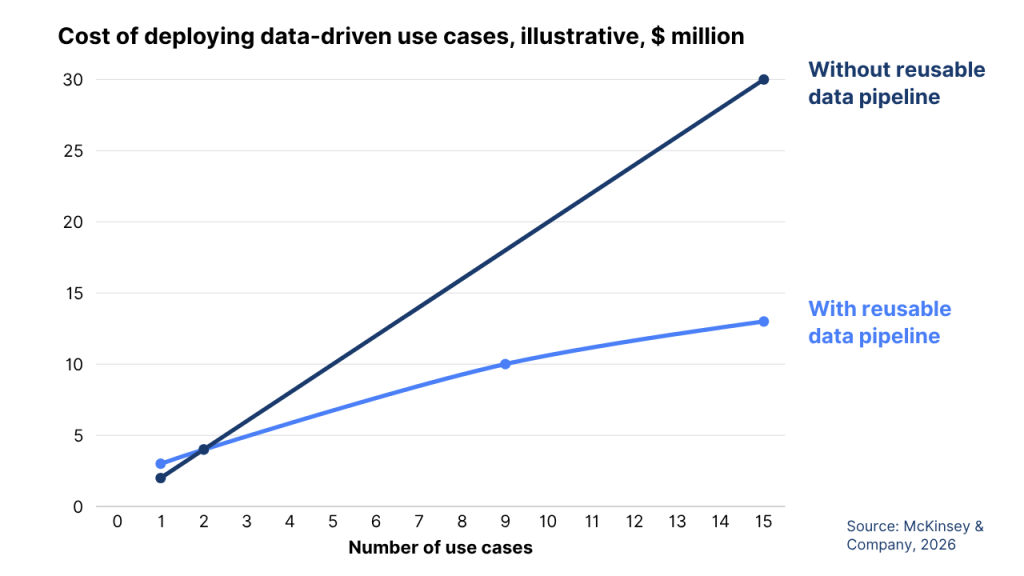
Deploying 15 data-driven use cases without a reusable pipeline reached roughly $30 million in costs. With one, the cost came in around $13 million. The savings compound with every additional AI use case.
Why Unstructured Data Bottlenecks AI at Scale
Unstructured content behaves differently from structured database records. It gets transformed through extraction, chunking, and embedding, and each transformation alters the context of the underlying data. An AI system’s outputs depend on which pieces it pulls and how it reassembles them.
A document can be accurate in full and still generate a wrong answer if the model retrieves an outdated fragment or misses key context. Small changes in what the system retrieves lead to very different outputs.
Traceability suffers as well. A single response may combine fragments from many documents, so tracing an answer back to its source becomes difficult. In regulatory audits or legal discovery, lack of traceability can result in costly penalties.
Risk expands too, as governance applied at the document level may not hold when only parts of that content are used. Sensitive information buried in emails, transcripts, or images can surface in outputs even when document-level access controls are in place.
What a Reusable Unstructured Data Foundation Includes
The case study points to a foundation built on governed data and repeatable infrastructure. McKinsey identifies six disciplines that must evolve to support AI at scale:
- Observability that makes the assembly of context and the production of outputs visible end to end, not just the movement of data.
- Data quality management that maintains accuracy across extraction, chunking, retrieval, and generation, so outdated content stops influencing responses.
- Metadata management that makes ownership, sensitivity, and allowed usage explicit for every extracted object.
- Data lineage that captures each derived artifact influencing an output, so any answer traces back to its source.
- Governance and controls that persist from storage to AI runtime, filtering sensitive content during retrieval and generation.
- Platform and tooling architecture that standardizes how unstructured content becomes AI-ready across teams.
Together these disciplines turn scattered content into curated, discoverable datasets that any AI application can trust.
Connecting the Foundation to the Wider Data Estate
Unstructured data remains the harder, less-solved side of AI readiness. It makes up over 80% of enterprise data and drives most of the shifts making data management more complex.
A governed unstructured foundation also enhances the rest of the data estate. Once documents, communications, and transcripts carry clean metadata and lineage, they connect to structured enterprise data downstream, anchoring content to customers, contracts, and transactions. That linkage lets AI systems interpret content consistently across applications, strengthening reliability.
How Readiness Compounds Into ROI
The economics of McKinsey’s case study come down to reuse. A reusable foundation lowers the marginal cost of every new use case, so the return grows as AI scales. McKinsey frames readiness around four metrics: reuse, reliability, governance, and scalability.
Firms that build this foundation early pull ahead, while competitors that keep rebuilding pipelines for each AI project carry rising costs and inconsistent outputs.