
AI data security is no longer an emerging concern; it’s an operational reality. According to the 2026 Data Security and Compliance Risk Forecast Report, 100% of surveyed organizations now have agentic AI on their roadmap. The question for enterprises is no longer if AI will touch sensitive data, but how much and under what controls. Many have already deployed agentic AI into production workflows, but far fewer are prepared to govern it.
The report highlights a market at an inflection point. AI adoption is proliferating rapidly while governance, visibility, and enforcement fall behind. The result is a widening gap between organizations that can safely operationalize AI and those that are accumulating unmanaged risk.
The forecast outlines predictions for 2026 based on a survey of 225 security, IT, and risk leaders across 10 industries and 8 regions. This analysis focuses on the 10 highest-confidence predictions for enterprise AI governance: the capabilities that will determine whether organizations scale AI with confidence or confront regulatory, security, and operational failures.
Unified Governance Becomes the Baseline
Prediction 1: DSPM Becomes the Default Data-Protection Baseline
By the end of 2026, Data Security Posture Management (DSPM) is expected to be a baseline requirement for mid-to-large enterprises. On paper, adoption looks strong: 86% of organizations report having DSPM protocols in place. In practice, enforcement tells a different story.
Only 39% can consistently enforce tagging and classification across data channels, while 61% cannot. Another 34% have partial coverage, where classification fails to propagate across all systems, and 16% rely on channel-specific controls where data loses its tags when it moves systems. This enforcement gap matters because AI systems rely on data mobility. When labels disappear, so do guardrails.
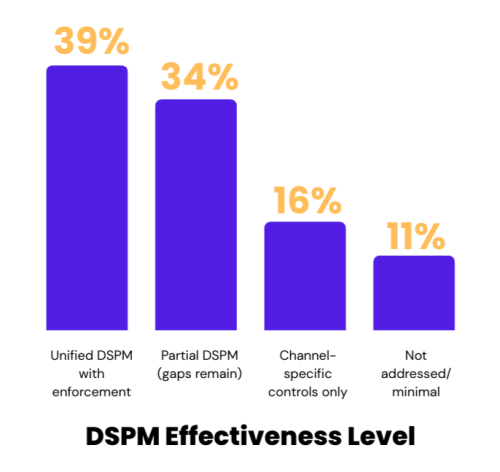
DSPM policy without enforcement is just “expensive monitoring.” In AI environments, visibility alone does not prevent misuse, leakage, or regulatory exposure.
Prediction 2: Data Governance Operating Models Go “Managed-by-Default”
Governance maturity is becoming measurable. “Managed” governance—defined by consistent execution, metrics, and partial automation—is emerging as the expected baseline. Yet 37% of organizations remain below that threshold, operating governance models that exist on paper but aren’t consistently executed.
Only 28% have reached “Managed ” maturity, while 20% remain stuck at “Defined” (policies documented but not reliably followed) and 4% operate ad hoc. Even among organizations that claim higher governance maturity, 25% still rely on manual or periodic compliance processes.
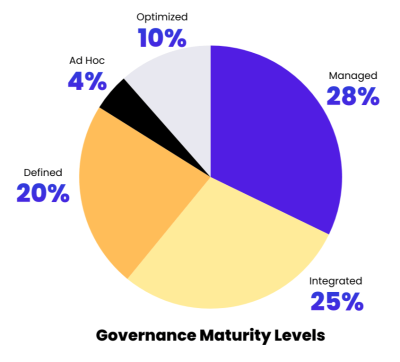
In an AI-driven environment, where data usage changes continuously, periodic evidence collection is no longer defensible. Regulators increasingly expect continuous proof, not quarterly attestations.
Prediction 3: Centralized AI Data Gateways Become the Control Plane
Centralized data platforms will become the expected architecture for governing sensitive data flowing through AI models, but most organizations don’t have this yet, even as AI use cases multiply.
Only 43% of organizations have centralized AI data gateways today. The remaining 57% rely on distributed, partial, or nonexistent controls.
The breakdown is stark:
- 27% use distributed controls with clear policies
- 19% rely on partial or ad hoc controls, having cobbled together point solutions without coherent policy
- 7% have no dedicated AI data controls at all
These models fail to scale. Distributed controls may suffice for a single copilot, but not for environments running internal copilots, API integrations, agentic workflows, document-generation, and decision-making systems simultaneously. Data fragmentation leads to inconsistent governance enforcement and blind spots precisely where AI risk concentrates.
Most organizations will spend 2026 trying to retrofit centralized controls onto AI systems that were deployed without them. Meanwhile, those that establish centralized governance early will be better positioned to adapt as AI risk and regulatory pressure accelerate.
AI Risk Becomes Structural
Prediction 4: Agentic AI Use Cases Go Mainstream — and Touch Critical Channels
Across industries and business sizes, agentic AI is on every organization’s roadmap. A third of organizations are planning autonomous workflow agents (33%), and nearly a quarter are planning decision-making agents (24%). These systems act and execute business logic without human approval at every step, accessing sensitive data while integrating directly with critical infrastructure.
Despite the exposure these systems introduce, containment readiness falls behind. Only 37% of organizations can enforce purpose limitations, and just 40% have a kill switch to terminate misbehaving agents. The mismatch is most visible in high-risk channels: 27% are planning AI-driven managed file transfer automation, but over half of organizations lack adequate MFT security. Organizations are deploying AI far faster than they are prepared to govern it, adding autonomous agents to channels they have not yet secured.
Prediction 5: AI Data Security and Privacy Remain the Fastest-Growing Risk Cluster
AI-related risks are now the top enterprise security and privacy concerns. The leading issues cited include:
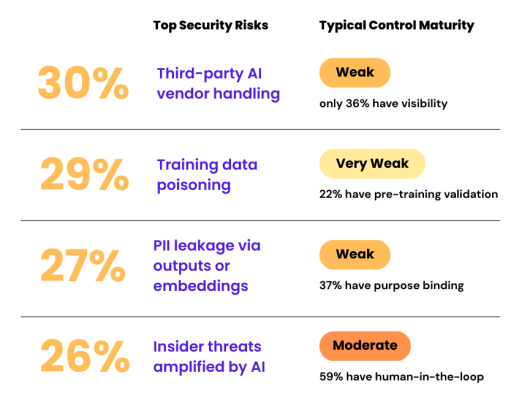
Despite high concern, control maturity remains low. Only 36% have visibility into how third-party AI vendors handle data, and just 22% validate data before it enters training pipelines.
Recent joint research by Anthropic and Oxford University underscores just how vulnerable AI can be without pre-training data validation. The study found that just 250 poisoned documents were enough to compromise models of all sizes. Whether the AI had been trained on 6 billion or 260 billion tokens, those 250 samples were enough to distort its reasoning.
That’s roughly 0.00016% of the dataset, yet the damage was systemic and irreversible. If just a couple hundred documents can permanently poison an LLM, pre-training validation will be a non-negotiable requirement in 2026.
Keystone Capabilities Separate Leaders From Laggards
Prediction 6: Evidence-Quality Audit Trails Become the Keystone of AI Governance
Audit trails correlate more strongly with AI maturity than industry, organization size, or region. 33% of organizations lack evidence-quality audit trails entirely, and 61% operate with fragmented logs across systems.
Organizations without audit trails show dramatically lower maturity across every AI dimension:
- 32 percentage points less likely to have AI training data recovery
- 26 points behind on purpose binding
- 20 points behind on human-in-the-loop controls
Only 39% of organizations have unified data exchange with audit trail enforcement. The remaining 61% have disaggregated data exchange—separate systems for email, file sharing, MFT, AI tools, and more. This architecture produces partial logs scattered across platforms, each in its own format with its own retention policy. When incidents occur or auditors ask questions, security teams spend days manually correlating logs across systems, trying to reconstruct events that should be immediately provable.
Prediction 7: Training-Data Controls and “Unlearning-Ready” Architectures Become Regulatory Requirements
Training data governance is a systemic weakness. 78% of organizations cannot validate training data before use and 77% cannot trace data provenance. That means when a regulator asks, "How do you know there's no PII in your model?" 78% of organizations can't answer, and 77% can’t answer “Where did this data come from?”
When a data subject exercises deletion rights under GDPR, CCPA/CPRA, or emerging AI regulations, over half of organizations have no mechanism to remove their data from trained models. They will either retrain from scratch, which is expensive and impractical, or hope no one asks, which is increasingly risky. Enterprises are under rising pressure to get it right before ingestion. In agentic AI systems that retrain continuously, data errors compound across multi-step workflows, turning a single ingestion mistake into a permanent governance failure.
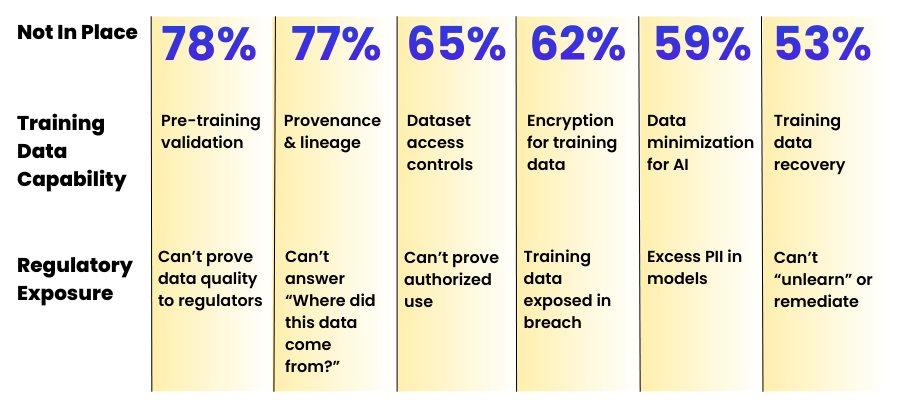
The "right to be forgotten" is coming for AI. Training data controls are becoming a regulatory requirement, essential for both compliance and incident remediation.
Governance Pressure Moves Up and Out
Prediction 8: AI Governance Becomes a Board-Level Risk Domain Everywhere
Board attention to AI governance is the single strongest predictor of AI maturity in the survey. 54% of boards don’t have AI governance in their top 5 topics, resulting in a 26 to 28 percentage point maturity gap across every major AI control metric compared to organizations with AI governance in their top 5 board topics.
When boards treat AI governance as a priority, organizations invest and close capability gaps more effectively. Where boards aren’t paying attention, AI governance remains fragmented and underfunded.
Prediction 9: The EU AI Act Creates a Global Governance Template
Organizations subject to the EU AI Act are significantly more mature in building governance infrastructure than those outside its scope. Those not impacted by the EU AI Act are:
- 22 points behind on purpose binding
- 33 points behind on AI impact assessments
- and 84% haven’t conducted AI red-teaming
Although 82% of U.S. organizations report no EU AI Act pressure today, the regulation is spreading through supply chain requirements, multinational operations, and competitive benchmarks. It is rapidly becoming the de facto definition of “good AI governance” as the framework becomes the global baseline.
Prediction 10: Data Sovereignty Becomes an AI Governance Imperative
Organizations have largely solved sovereignty for storage, but not for AI processing. 29% cite cross-border AI data transfers as a top exposure, yet only 36% have visibility into where data is processed, trained, or inferred.
AI breaks traditional sovereignty models that address data at rest. A prompt sent to a cloud AI vendor may be processed in another jurisdiction, used to fine-tune models hosted elsewhere, or generate outputs that traverse borders. Regulatory expectations are shifting accordingly. Compliance now depends on demonstrating control over AI workflows, not just where data sits at rest.
The Path Forward: Closing the AI Governance Gap
The data reveals a consistent pattern: organizations are investing in monitoring, but lagging in enforcement. To close that gap, leaders should focus on five steps.
- Elevate AI governance to a board risk domain. Organizations with board engagement outperform peers by more than 26 percentage points across governance metrics.
- Build keystone capabilities first. Evidence-quality audit trails and training data controls predict success across nearly every AI control metric.
- Unify governance across unstructured data channels. Fragmented infrastructure prevents enforcement, sovereignty, and auditability.
- Extend governance from storage to AI processing. Sovereignty now applies to inference and training, not just infrastructure.
- Close the gap between observing AI and controlling it. Monitoring without enforcement leaves organizations exposed when something goes wrong.
2026 Is the Year AI Governance Becomes Operational
AI adoption is universal, but governance readiness is not. In the coming year, organizations will be defined less by how quickly they deploy AI and more by whether they can prove control, respond to incidents, and meet rising regulatory expectations.
The forecast data paints a crystal-clear picture of 2026: those that invest early in governance foundations will scale AI with confidence, while those that do not will confront the consequences.